Showing posts with label multi-faith. Show all posts

Sunday, September 11, 2011

10 Years On...

Yes, its ten years on (not since my last blog post, but close...)... Ten years on since the world changed in profound ways as the result of the terror attacks on the Word Trade Centre and the Pentagon in the US. It's hard to remember life before the very bizarre "the war on terror" that followed and remains with us to this day.

One of the things that has changed, of course, is the perception of Muslim people in our world. 

Research has shown that there has been a dramatic rise in the levels of demonisation that Muslim people have experienced across the globe since the 2001 attacks. There seems to be a new xenophobia in town, or at least new expressions of old xenophobia that has been lurking not too far from the surface of our communal life. This developing mindset has coloured our own our nation's views on worthwhile pursuits like multiculturalism and the processing on asylum-seekers.

Personally, I don't know that many people who identify as "Muslim". I could count them on one hand. But when you know someone, it certainly cuts through all the xenophobia that swirls around you... When I was a school chaplain, one of the teachers at my school was a devout Muslim - a lovely, lovely man. One day, I was preparing to do some religious teaching in a class that this teacher was presiding over and he asked me if he could say something before I began. I wasn't too sure if I should let him (him being "Muslim" and all) but it was his class, what was I going to do? Besides, he was such a great guy... So, he spoke to the class for two or three minutes about the importance of God, and that even if God wasn't high on their agenda at the moment, if they listened, maybe later on in their lives their agenda might change and something they heard today might come back to them and be useful. He then handed back to me... but I was at a loss for words... I felt as thought the religion lesson had been well taught - well, it had been to me at least... 
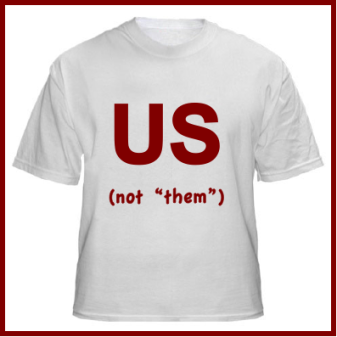
I was so impressed with his words and his inclusion of me in his spiritual world. He had been far more gracious towards me than I would have been towards him. Something quite profound changed in me as a result of that exchange... It helped me to see that while we can spend a lot of time trying to work out who is "us" and who is "them, that mostly, I think, in a lot of ways, it is just all "us" out there, trying to work it all out and make the most out of our lives.

My encouragement on this suspicious anniversary is to go and hug a "them" today... Well, at least say "hi"... particularly if you are planning on hugging them next... Anyway, I'm sure you'll work it out...

Shalom

Steve

Saturday, November 13, 2010

Challenging the Chaplains

I remember going to the cricket one day with a group of friends, and one of them asked me how work was going (I work in the training department of SU Qld, the largest employing authority for state school chaplains in Queensland). I got about one or two sentences into my reply when he said, "You know, I really wish you guys didn't do what you do. I mean I like you and all, but I don't like the idea that there are chaplains in schools." Quite an interesting conversation took place after that. It is not the last one I have had, nor am I the only person who has been having these conversations. There has been a bit going on about it in the media over the last few years. 

The first 'outsider' view I wanted to share as part of my blogging 'come back' is about chaplaincy - a subject that is close to my heart. Not only do I work for SU Qld, but I have also worked as a chaplain in a high school. Compass, the ABC program that looks at issues of spirituality and religion in Australia, recently did a program called "Challenging the Chaplains." It looks at both sides of the "Chaplaincy debate" and challenges the place and value of  School-based Chaplaincy. 

I haven't got any comments I want to make about the program particularly. Maybe just to encourage you to watch the video, read some of the comments that people have made afterwards and reflect on it yourself.

To go to the Compass website and watch the program, "Challenging the Chaplains", click here ...

Shalom

Steve

The View from the Outside...

Well, only one post in four months, and that one was really just an apology for not doing any posts... Not a great record in recent times, but one I hope to rectify over the next few months at least. My study is over for the year, and my plan is to allocate some of my freed-up mental real estate to greenspacey type things, at least between now and mid-Feb 2011 when it will all start up again...

There are a few things on my mind today, and they all relate to "outsider" views on faith and spirituality and so that is what I want to start up on today. I have spent quite a bit of energy in the last few years reading about and listening to views on faith and spirituality from those outside of it, and I have had a number of chats with people who currently sit in this place. For those who hold faith of some sort, this is an extremely worthwhile yet threatening experience. Worthwhile in the sense that there is nothing like an outsider to help you to see your blindspots, and threatening in the sense that their is nothing like an outsider to help you see your blindspots.

In the recent subject I taught at Christian Heritage College (WE301 - Reflections on Human Services) we looked a lot at Michel Foucault's ideas around "discourse", which is essentially about worldviews and ideologies, the associated power arrangements, and the concepts, language and structures infused in those ideas and associated power arrangements. You often hear the terms "dominant" discourse or "competing" discourses in the literature on this stuff. It is very post-modern... One of the quotes I loved was that any kind of ideology or worldview we adopt is a "kind of violence" done on reality, because as soon as we begin arranging 'what is' into some set of ideas about 'what is' we have to  do a fair bit of cutting, pasting, blocking out, focusing on, ignoring this and emphasising that etc etc to make it fit in well enough... So in this way, none of us can have it totally right and none of us can have it totally wrong...

Another related set of ideas we talked about was Paulo Friere's material on "dialogue", which is basically about a  way of approaching and engaging with the different ideas, worldviews and discourses of others. This is done in such a way so as to genuinely consider the views of others, what value they might have in themselves, and even what value they might have for ourselves. In some ways it is an acknowledgement that each of us only have a particular worldview or discourse on life  that we are working with, and that others might have picked up on something that we've missed - like a blindspot for example...

One of the things we talked about in this class was whether Christianity was simply another discourse; that is, another way in which the cosmos can be arranged in our minds, communicated to others, argued about and used as a power tool (so to speak)... Some thought this could be right, others thought that something like Christianity sits above all discourses. We considered the "Big T" truth claims of faiths like Christianity and put them up against the "little t" truth claims of postmodernism and tried to locate ourselves in this apparent dichotomy. I wonder if people of faith, at best, can claim that they believe in "Big T" Truth (EG - God, the Bible etc) but have to admit that they can only ever know this in a "little t" truth kind of way (IE - through their own set of 'life goggles'). There is nothing wrong with this position. But if it is "true", then it is a good thing to acknowledge. It might help to keep us humble, with our adopted truth claims in check, open to what God has been revealing to others about 'what is'.

Over the next few weeks, I want to blog on about some examples of outsider views that are out there at the moment and challenge us all to consider what it is that we might need to consider and take on from these views. After that, towards  the end of November, we're going to engage in a few reflections for Advent in the lead up to Christmas. You are most welcome to come along...

Shalom

Steve

Monday, August 30, 2010

My Apologies For My Blogging Slackness

I just wanted to apologise for my blogging slackness. I've been very busy with work and I've started some post-grad study at uni in politics and government. I can say that my blogging on spirituality in the public sphere, with an emphasis on the political realm, has lead me down this path. Maybe one day, I'll actually know what I'm talking about. Oh, and I also lost my ipod, which was a major source of podcast information and inspiration...

Oh, and I have a wife and kids... They are quite time consuming as well... but also quite nice really...

The really sad thing is that there has been quite a lot going on that I would have liked to babble on about. I would like to have shared a few more thoughts on different people's reactions to Julia Gillard being an atheist. I got some great emails sent to me by different people claiming that she was the anti-Christ etc etc, and then she went and trumped God's own party (the coalition in case you were wondering) by pledging $65 million more than them for the contunuation of chaplaincy over the next three years. I don't know why, but I just thought that was really funny...

Then there was the "ban the burka" debate... now this is fascinating. Bans are already in place in European countries like France and Belgium, and the discussions have already started here. Amazing stuff - what does it mean to be a free society? Should Muslim women be free to wear the burka or should they be freed from wearing it? Anyway, I just haven't had the time to go into it... but I'm sure it's not the last we've heard of it.

Also, I finally finished the "His Dark Materials" trilogy after about a year of reading. Those three books together were about a metre thick. You might have heard of the movie, "The Golden Compass". Well it was that set of books - the "anti-Narnia", a supposed atheistic fantasy novel. That stuff was there, and it was also a ripping good read! I'm back into "Doubts and Loves " by Richard Holloway, but can't seem to get motivated to keep going with "God Delusion".

And then on the weekend, in The Australian Magazine I think, there was an article about guilt and how in some ways modern society has done away with it, along with religion, but in another sense it has just transferred it to a different set of "deadly sins" (one of which was to have religious belief)... There was some interesting discussion about whether the loss of guilt in our modern world had been a good thing or a bad thing. Interesting stuff going on out there...

Anyway, I saw the light on and thought I'd drop in... just touching base, checking in etc etc... I'm not sure when I'll get onto this beast again but I hope it's soon. There are heaps of interesting things going on out there that are greenspace blog-worthy. If I don't get to them and start talking about them, make sure you do...

Shalom

Steve

Wednesday, February 3, 2010

God is Back (revisited)

In the middle of last year, I did a blog post called "God is Back" based on an article in The Australian about a book by the same name. The theme of the book is the surprising rise of faith, spirituality and religion across the world our journey into an apparently more rational and secular age.In 1999, The Economist published God's obituary, but 7 years later had to change their tune. "God is Back: How the Global Rise of Faith is Changing the World". is written by John Micklewait (editor-in-chief on The Economist) and Adrian Wooldridge (Washington bureau chief of the London-based weekly magazine) and looks at the reasons why spirituality and religion have persisted in the modern world when many predicted that it would die off in a puff of well-reasoned secularism.

I haven't got anything much more to say about that. This post is really to point you toward a very charming and amusing ABC Radio National podcast of an interview between John Micklewait and Phillip Adams, Australia's best-known atheist. The interview, originally broadcast in July last year) is about the book (the podcast is also called "God is Back"). Adams, with good grace, bemoans the book's findings and, with his tongue firmly in this cheek, confesses his growing dislike for the author. The exchanges between the two are quite delightful.

Anyway, I hope you enjoy it...

Shalom...

Sunday, January 3, 2010

Whatever Happened to Secular Democracy ?

On the 28th of December, Ross Fitzgerald wrote an article in The Australian called "Whatever Happened to Secular Democracy?" In it, he complains about how religion is making its presence felt more and more in Australian politics. Although it is not really clear what solution he is proposing, he seems to be putting forward that either Christians shouldn't be in politics; that Christians shouldn't try to influence politics; or that Christians should slice off the Christian part of themselves when in politics.

It is all very interesting... And it seems that many people thought so as well. There were about 180 comments attached to the online version of the article and space given to 6 related letters to editors in The Weekend Australian.

Just a few thoughts...

Firstly, it seems to me that Ross (and others) doesn't really understand what a "secular democracy" is or what is meant by "the separation of church and state". Neither concepts are designed to keep religion out of politics, but to ensure that no one religion is owned by the state or that the state is owned by one religion for that matter... If people elect Christians into various political offices, then that is democracy in action. If Christians lobby for what they want to see happen in politics, then that is democracy in action. If Christians in politics act Christianly (or otherwise) in the performance of their duties, then that is democracy in act
ion. If people don't like any of that, then they can also engage in the democratic process and get their agendas on the table and try to make whatever it is they want to have happen, happen. They can also elect representatives who aren't religious if they want to. This happens all the time. So, "secular democracy" means that religion has a place in public life, whether people like ior believe in a religion or not. To actually exclude religion from public life would be undemocratic and not in the spirit of secularism.

Secondly, everyone has some kind of worldview, schema, philosophy of life etc etc that they live by - some are "religious" and some are "secular". These are the values that guide people's actions - even politicians! To ask a person to engage in politics and slice off their source of values as they do so, is crazy talk... No-one would ask this of a non-religious person. I think the challenge for Christian politics is to engage in democratic processes in a Christian way, that doesn't just promote the wellbeing of Christians, but of all the people they were elected to represent.

Thirdly, religion is political. People who go on about keeping religion personal and out of public life do not understand the scope of the spiritual agendas of most religions. "Personal salvation" and "personal faith" are only parts of the story. Both Old and New Testaments talk about economics, politics, citizenship, war, peace, refugees, the poor, the environment etc... The Jewish concept of "Shalom" is about cosmic renewal, and God's interest in all areas of life.

I think that the concept of "Shalom" is a useful one for Christians in politics.
Understanding these things, we can see a place for religion and spirituality in public life.

Shalom...

Wednesday, December 2, 2009

Christianity and Politics

I just listened to a very interesting podcast by Tony Campolo entitled "Christianity and Politics". It was recorded before Barack Obama became the President of the USA and includes a great quote from him.

I'd recommend a listen to it if you are into such things. It can be found by clicking here ...

Shalom...

Steve

Tuesday, December 1, 2009

The Rise of "The Mad Monk"

Is anyone else concerned that the nick name of the new opposition leader is "The Mad Monk"? Tony Abbott ended a pretty tumultuous week for the Coalition by getting voted in as the new leader of the party by 1 vote. He certainly seems to have a big job ahead of him to unite the party and start moving ahead towards the next election.

Not everyone is thrilled with the choice of "The Mad Monk" as new leader. Some have concerns with the "mad" part, saying that he is a bit erratic and outspoken, while others are more concerned with the "monk" part. In The Australian today, there were a number of articles about him, describing him as "Conservative" and as a "Devout Catholic". These terms appeared almost always together, painting them as related traits, if not as the same thing. In Tony Abbott's case, this is probably true. In Australia, there has been a long relationship between Conservative politics and the mainstream Christian churches. And for each of us, there is certainly some connection between our worldview or spirituality and our political ideology.

Eva Cox, the Chairwom
an of WEL (Women's Electoral Lobby) said that Tony Abbott, "lets his personal religious views interfere with his political role and I think that that's a problem." In 2004, talking about the relationship between his faith and politics, Abbott said, "Christian politicians can not check their faith into the parliamentary cloakroom and be otherwise indistinguishable from everyone else. Still, modern society is not a community of believers and the parliament is not the place to make rules for one." I think that Tony Abbott "gets it". He is no dummy and has clearly thought through his own position on this.

I don't know anyone who checks their world view or spirituality into the 'cloakroom' before before doing their job or living their life. We all certainly have to apply our world view appropriately in the context we find ourselves in at any given time. Our world view is the means by which we engage with and interpret the world, and this most importantly applies to those areas of life where difficult decisions need to be made or strong points need to be debated (EG - in politics!). On one hand, I find it odd that some people expect politicia
ns to 'check their faith' into the cloakroom and then perform their political role.

It reminds me of those old Warner Brothers cartoons with the sheep dog and the coyote, where they used to clock in, fight like blazes, then clock off and go home arm in arm. This was funny because it was a bit ridiculous. I don't know any politicians who don't profess some kind of faith who are expected to leave their world view and values in 'the cloakroom' before doing their job. So, I think that there is a double-standard going on here to an extent.

On the other hand, I don't think that politicians should push their personal beliefs, spiritual or otherwise, in the political arena. The role of politicians is to represent the needs, wishes and desires of their electorate, and to do this in such a way so as to reflect their personal faith stance or world view.

Being a politician in a truly democratic society, seems to me to mean that you would need to ensure that you were representing all the views of your electorate with integrity, and work out the way you would do that "Christianly" (whatever that looks like)... As well as this, in a truly democratic , and even secular, society, those of the Christian faith have a right to engage in the political processes and have their voices heard. Politicians certainly have a right to be Christians and participate in the process without slicing themselves up into spiritual and non-spiritual beings.

Whatever that looks like... So, to all you Christian politicians out there - good luck with that...

Shalom...

Thursday, September 10, 2009

An Aussie Bill of Rights & Freedom of Religion

You may or may not know that there has been a national consultation going on about how to best protect Human Rights in Australia. Some of this discussion has been around whether Australia needs a Bill or Charter of Rights like many other Western countries have, although a number of other processes have been suggested and are up for discussion.

If you're interested in finding out a little more about the process, click here to go to the consultation website, and / or click here to listen to a podcast about the current progress on the consultation.

But all that is just the entree. The main course for this blog post is yet another podcast I listened to the other day. It was from the ABC's "Life Matters" program, and it was very interesting. It had a number of people from different religious groups in Australia, talking together on a panel about how a Bill of Rights might effect freedom of religion in Australia.


To listen to this one, click here ...


Shalom...

Wednesday, June 24, 2009

God is Back...

My old friend, The Weekend Australian, published an article on the weekend entitled, "Nations Prosper with God on their Side." It was essentially an edited abstract from a new book called, "God is Back: How the Global Rise of Faith is Changing the World". The book is written by John Micklewait (editor-in-chief on The Economist) and Adrian Wooldridge (Washington bureau chief of the London-based weekly magazine) and looks at the reasons why spirituality and religion have persisted in the modern world when many predicted that it would die off in a puff of well-reasoned secularism.

The book seems to be social/cultural/historical examination of the relationship between religion and modernity, and traces two histories of the development of modern culture in Europe and America, and thier two very different approaches to religion. The European idea is that you can't become modern while holding onto religion, and the American idea is that you can become modern and still find a place for religion in public life. There is much more to it, but that seems to be the main thrust.

Anyway, read the article or buy the book... (I've read the article but will have to ask my wife whether we can spare $60 for the book)...

At the end of this article, the authors say, "The basic message of our book is a profoundly liberal one. Unevenly and gradually, religion is becoming a matter of choice - something that individuals decide to believe in (or not). Secularists need to recognise that the enemy that "poisons everything" is not religion but the union of religion and power and believers need to recognise that religion flourishes best where it operates in a world of free choice, that, as that doughty free thinker Benjamin Franklin once put it, "When a religion is good, I conceive it will support itself; and when it does not support itself, and God does not take care to support it so that its professors are obliged to call for help of the civil power, 'tis a sign, I apprehend, of its being a bad one."

There are two points that particularly interest me here. The first is that "religion flourishes best where it operates in a world of free choice". The reason this interests me is because of my role in SU Qld in developing state school chaplaincy. What a lot of people don't realise with Chaplaincy, is that Education Queensland defines Chaplaincy - not SU Qld. Chaplaincy is an Education Queensland program that SU Qld is accredited to deliver on their behalf, not an SU Qld program that we deliver in Education Queensland schools. As such, Education Queensland policy says that, "Programs of chaplaincy services are [must be] compatible with policies and practices that apply to delivery of any service in a multi-faith and multicultural state school community". This is not a situation that many Christians would be, or are, comfortable with. They would rather that state governments were a theocracy; that Christians ran the show in relation to Chaplaincy and Christian ministry in schools; and that Christians had preferential access to schools and the kids in them for evangelistic purposes.

What "God is Back" seems to suggest to us, is something that many of us have suspected for awhile. And this is, that the situation we have in Queensland schools, with all faiths and worldviews "getting a seat at the table", is the best situation that any religious group could hope for. Not only does it make the most sense in a modern, pluralistic, multi-faith and multi-cultural society that this would be the case, as it turns out, it is actually the situation that best promotes spirituality in a society. It could then be argued that the best and fairest thing for Christians to do in such a society, is not to fight for "Christian" access to schools, but to continue to fight for the access of all faiths and religions to schools. It is in this environment of "choice and competition" that real faith and spirituality seems to flourish.

The second point that interests me is found in the quote from Benjamin Franklin. That, "When a religion is good, I conceive it will support itself; and when it does not support itself, and God does not take care to support it so that its professors are obliged to call for help of the civil power, 'tis a sign, I apprehend, of its being a bad one. The presence of Christians in schools should result in people being able to see that the "God things" in life equal the "good things" in life. If our faith is any good, then we shouldn't need to ask the government for preferential treatment and access to kids to promote the Christian cause (however we understand this). Schools should be knocking down the doors to get Chaplains and churches into schools because they know that their children, young people, staff, families and whole school community, are going to be better off from the association.

Happily, this is that case in many situations. And where it is not, let's hope that the Christians are asking themselves why?

Shalom...

Wednesday, April 8, 2009

The Chapel with No Crucifix

The Mossman Daily paper reports that the chapel at the Royal North Shore Hospital has had its crucifix, Bibles and all other Christian symbols removed to avoid offending people of other faiths. Apparently, this is not as a result of any pressure from any religious groups, just the decision of state government bureaucrats.

Read the article here...

I'm not sure that this is the best way for people of different faiths to interact with each other in Australia. What does hiding or denying the symbols of various spiritual beliefs and cultures in publicly shared spaces say to people about the place of spirituality in our individual and collective lives? It suggests to me that spirituality is a private thing that doesn't belong in the public realm. I think that this view reflects a popular, but erroneous dualistic view of spirituality that leads to a harmful slicing up of people's private and public lives that is not natural. My very real concern is that this kind of thinking is taking hold as the leading way of dealing with public expressions of diverse spiritual and religious views and that the outcome for us will be a culture that is spiritually fearful, intolerant and even more spiritually deficient than it is now.

I'd like to suggest that there is another way that might lead to a more spiritually engaging cultural landscape for our communities. What if (crazy as this sounds), we encouraged people of different faiths to respectfully engage with each other, talk about their similarities and differences, and to seek to benefit from each other's teachings and experiences? What if we encouraged people to take an interest in the various public expressions of diverse religious beliefs and to befriend people who don't believe, look or act in the same way we do (whichever "we" you happen to be)...

I've been reading some books by Vinoth Ramachandra lately (you'll see some in my bookshelf on the right hand side of this blog), and he suggests that the best foundation for spiritual interaction in our modern world of different faiths and ideas is to allow and promote respectful and robust engagement between people of different faiths. To the extent, that genuine "conversion" to the other's views should be possible as we allow the perspectives of others to critique our own, and vice versa.
This alternative "public offense" stance that we are seeing a bit of will lead to spiritual intolerance and blandness that will be to our society's detriment.

I know a lot of bad things that happen are attributed to religion, but that is a niave point of view, that fails to take into consideration the cultural and historical factors that influence a society's spiritual and religious expressions at any given time.
Like ours at this time. How do we define the decision to remove the Christian symbols from the chapel? Is it a political, legal, cultural, historical or spiritual decision that has been made? How we answer that question will say a lot about how we view spirituality and its role in private and public places, and whether societal expressions of spirituality can be separated from their cultural and historical influences.

Shalom...
 
You will need to update the "xxxx-x" in the sample above with your own Google Analytics account number. Note that the following line of code must be placed on the page before any reference to the pageTracker object. var pageTracker = _gat._getTracker("xxxx-x");